Internal Design
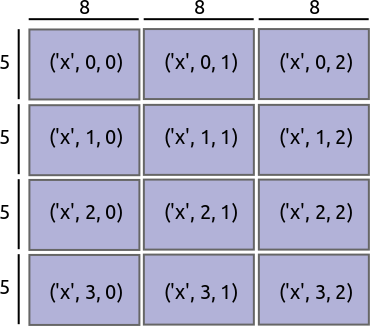
Dask arrays define a large array with a grid of blocks of smaller arrays. These arrays may be concrete, or functions that produce arrays. We define a dask array with from the following components
- A dask with a special set of keys designating blocks e.g. ('x', 0, 0), ('x', 0, 1), ...
- A sequence of chunk sizes along each dimension called chunks e.g. ((5, 5, 5, 5), (8, 8, 8))
- A name to identify which keys in the dask refer to this array, e.g. 'x'
Keys of the dask graph
By special convention we refer to each block of the array with a tuple of the form (name, i, j, k) for i, j, k being the indices of the block, ranging from 0 to the number of blocks in that dimension. The dask must hold key-value pairs referring to these keys. It likely also holds other key-value pairs required to eventually compute the desired values, e.g.
{
 ('x', 0, 0): (add, 1, ('y', 0, 0)),
 ('x', 0, 1): (add, 1, ('y', 0, 1)),
 ...
 ('y', 0, 0): (getitem, dataset, (slice(0, 1000), slice(0, 1000))),
 ('y', 0, 1): (getitem, dataset, (slice(0, 1000), slice(1000, 2000)))
 ...
}
The name of an Array object can be found in the name attribute. One can get a nested list of keys with the ._keys() method. One can flatten down this list with dask.array.core.flatten(); this is sometimes useful when building new dictionaries.
Chunks
We also store the size of each block along each axis. This is a tuple of tuples such that the length of the outer tuple is equal to the dimension and the lengths of the inner tuples are equal to the number of blocks along each dimension. In the example illustrated above this value is as follows:
chunks = ((5, 5, 5, 5), (8, 8, 8))
Note that these numbers do not necessarily need to be regular. We often create regularly sized grids but blocks change shape after complex slicing. Beware that some operations do expect certain symmetries in the block-shapes. For example matrix multiplication requires that blocks on each side have anti-symmetric shapes.
Some ways in which chunks reflects properties of our array
len(x.chunks) == x.ndims: The length of chunks is the number of dimensions
map(sum, chunks) == shape: The sum of each internal chunk, is the length of that dimension.
The length of each internal chunk is the number of keys in that dimension, e.g. for chunks == ((a, b), (d, e, f)) and name == 'x' our array has tasks with the following keys:
('x', 0, 0), ('x', 0, 1), ('x', 0, 2)
('x', 1, 0), ('x', 1, 1), ('x', 1, 2)
Create an Array Object
So to create an da.Array object we need a dictionary with these special keys
dsk = {('x', 0, 0): ...}
a name specifying to which keys this array refers
name = 'x'
and a chunks tuple:
chunks = ((5, 5, 5, 5), (8, 8, 8))
Then one can construct an array:
x = da.Array(dsk, name, chunks)
So dask.array operations update dask dictionaries and track chunks shapes.
Example - eye function
As an example lets build the np.eye function for dask.array to make the identity matrix
def eye(n, blocksize):
    chunks = ((blocksize,) * n // blocksize,
              (blocksize,) * n // blocksize)

    name = 'eye' + next(tokens)  # unique identifier

    dsk = {(name, i, j): (np.eye, blocksize)
                         if i == j else
                         (np.zeros, (blocksize, blocksize))
             for i in range(n // blocksize)
             for j in range(n // blocksize)}


    dtype = np.eye(0).dtype  # take dtype default from numpy

    return Array(dsk, name, chunks, dtype)